The AstroStat Academy
in a nutshell
Are you an astronomer feeling your knowledge of Statistics is not enough?

You know some Machine Learning but want to see inside the "black box"?

You are in luck
The AstroStat Academy is here to help!
What is the Academy
-We are an association of instructors committed to advancing education in statistics and machine learning.
Our mission
-
We operate on different fronts:
- Supporting early-career researchers and data scientists in mastering analysis tools they may only know superficially, or have previously struggled to learn without structured guidance.
- Preparing additional personnel to become instructors and assisting with the organization of teaching events.
Leveraging years of experience, the field knowledge of our instructors, and a carefully orchestrated curriculum supported by refined lectures, we have created a robust and well-tested teaching experience - enter the AstroStatistics School !
In a few words, we allow students to grow from amateurs to professionals: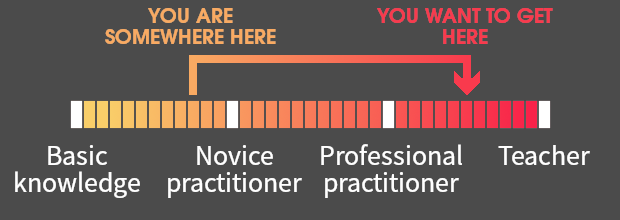
Our lectures are a mix of theory and hands-on applications, usually via Python notebooks. This successful recipy provides the necessary variety to keep the interest alive and the students engaged !
Our teaching philosophy is to go hand-in-hand with the students so that no one is left behind ! We encourage both teacher-student and student-student interactions.
Check us in action in this school we held in Sharjah (United Emirates, 2025):
Given that our target students are early-career scientists, our schedule always strikes a balance between "core" topics and "seasonal" ones.
This is what we covered so far, along with some subjects we would like to cover in future editions:
Notice that - however complex the topic may be - our notebooks are always meant to provide re-usable code that a student may readily refactor to their purposes with minimal effort !
- Core topics are always part of a school's schedule because they provide the essential foundation for all applications—fundamentals every researcher must master.
- Seasonal topics are state-of-the-art subjects that change from event to event so we can explore new trends in statistics, stay current, and invite dedicated speakers.
This is what we covered so far, along with some subjects we would like to cover in future editions:
| Core | Seasonal | Future |
|---|---|---|
| Classical Statistics Hypothesis Testing Optimization Bayesian Statistics MCMC ML/DL Introduction Clustering Classification Regression Model Selection ML Best Practices |
Time Series CNNs Diffusion models Simulation Based Inference GPU Parallelization Gaussian Processes Bayesian Optimization Citizen Science |
LLM pipelines AI Agents Knowledge maps |
Notice that - however complex the topic may be - our notebooks are always meant to provide re-usable code that a student may readily refactor to their purposes with minimal effort !
Our School was born in Crete in 2019, and after the Covid break, rapidly established itself as a serial event and expanded outside Greece.
And - why not?! - the next event may be in your very institute!
Click on one of the cards below to be redirected to that event’s webpage:
2019 Summer

2022 Summer

2023 Summer

2024 Summer

2025 Summer
2025 Winter
The target audience that will benefit most from this School is Astrophysics PhD candidates.
However, we do accept a wide variety of applicants, ranging from BSc students to professors, and from diverse disciplinary backgrounds, including Computer Science, Mathematics, and Signal Processing (to mention a few) - afterall, everybody needs a hand with statistics!
At every event, we like to keep the number of attendants constrained (around 30), in order to maximize the interactions between the students and the teachers.
We believe the aforementiond choices benefits the School in two ways.
On one hand, it provides an engaging learning experience by showing how the techniques can be applied across different domains.
On the other hand, it allows the teachers to address a broader range of needs and stay up to date with the latest developments in Machine Learning.
Stats from the Stats schools (Stats2 !)
Over the years, we collected applications from 600+ candidates, and we managed to instruct over 180 students from all over the world.The school outreach has been predominant around Greece, its birth-place, but we would now like to broaden it coverage - join us !